
Recent Projects
Building Green
Craftsman Homes have been building "green" for over 25 years. The trend started in the 1970's being "ecologically reponsible", has evolved into the concept of being green, which today encompasses almost every aspect of the building trade including: Passive solar, insulation materials and methods, solar electric generation, geothermal, water management, plant and animal habitat and greenscaping. In
a big way this trend was jump started when the federal government got
involved wholeheartedly, offering tax credits to individuals for such things
as solar arrays, insulation, energy efficient appliances, windows, doors
and geothermal heat pumps. Today is possible to obtain $60,000 to $80,000
in tax credits for building a green home.
Nevertheless the question of "what is green?" remains elusive.
Is it “green” to use a recycled material if it is shipped
a long way or polluted the air during manufacture, or if it off gases
and/or questionable chemicals when new?
As is so often the case in life, our choices involve balancing
the positive as well as the negitive aspects of each decision. What if
something will last 200 years instead of 40 years? Does this justify shipping
from a far away place if it will last five times as long? Often much is
saved doing something once rather than five times!
It was not concern for global warming that got the Suburbans off the road,
but rather the whopping $4 per gallon for gas.
Concurrently, some public and co-operative utility companies figured out
that by partially subsidizing energy efficient practices such as more
efficient air conditioners, better insulation , efficient appliances,
and double pane gas-filled windows, they could reduce demand and save
the cost of increasing capacity. It became a win-win situation, they save
money and so does their customer base.
To a great degree it is economics what determines change . We have seen
this with insulation. Spending $500 more on insulation will eventually
save $15 per month in electricity or heating fuel. That's a 3 year payoff!
Air conditioning compressors offers a similar savings, spending $2,000
more for a more efficient unit, gets a $400 rebate from the utility
company saving $25 per month on electricity. That's a 6 year payoff,
it makes economic dense to do that too!
Passive solar and innovative insulation reduce the size of geothermal heatpumps
and solar arrays. The water from the geothermal heatpumps supplies irrigation, promotes
greenery, cools the area around the house which in turn promotes cooling and thus the
electric demands of the home structure.
In
a big way this trend was jump started when the federal government got
involved wholeheartedly, offering tax credits to individuals for such things
as solar arrays, insulation, energy efficient appliances, windows, doors
and geothermal heat pumps. Today is possible to obtain $60,000 to $80,000
in tax credits for building a green home.
Nevertheless the question of "what is green?" remains elusive.
Is it “green” to use a recycled material if it is shipped
a long way or polluted the air during manufacture, or if it off gases
and/or questionable chemicals when new?
As is so often the case in life, our choices involve balancing
the positive as well as the negitive aspects of each decision. What if
something will last 200 years instead of 40 years? Does this justify shipping
from a far away place if it will last five times as long? Often much is
saved doing something once rather than five times!
It was not concern for global warming that got the Suburbans off the road,
but rather the whopping $4 per gallon for gas.
Concurrently, some public and co-operative utility companies figured out
that by partially subsidizing energy efficient practices such as more
efficient air conditioners, better insulation , efficient appliances,
and double pane gas-filled windows, they could reduce demand and save
the cost of increasing capacity. It became a win-win situation, they save
money and so does their customer base.
To a great degree it is economics what determines change . We have seen
this with insulation. Spending $500 more on insulation will eventually
save $15 per month in electricity or heating fuel. That's a 3 year payoff!
Air conditioning compressors offers a similar savings, spending $2,000
more for a more efficient unit, gets a $400 rebate from the utility
company saving $25 per month on electricity. That's a 6 year payoff,
it makes economic dense to do that too!
Passive solar and innovative insulation reduce the size of geothermal heatpumps
and solar arrays. The water from the geothermal heatpumps supplies irrigation, promotes
greenery, cools the area around the house which in turn promotes cooling and thus the
electric demands of the home structure.
Holistic Harmony House, "The Greenest House in Texas"
Nevertheless the question of "what is green?" remains elusive. Is it “green” to use a recycled material if it is shipped a long way or polluted the air during manufacture, or if it off gases and/or questionable chemicals when new? As is so often the case in life, our choices involve balancing the positive as well as the negative aspects of each decision. What if something will last 200 years instead of 40 years? Does this justify shipping from a far away place if it will last five times as long? Often much is saved doing something once rather than five times!Buckeye Trail
Providing a secluded sanctuary, Buckeye Trail is a mere "stone-throw" away from downtown Austin. This custom designed home merges California Craftsman with Prairie Craftsman to create a sophisticated architectural blend. The abode offers a majestic 270-degree view of Little Bee Creek Valley, the Texas Hill Country, and a view that includes The University of Texas Tower, complete with sunsets and sunrises. Mahogany and travertine show throughout the home, with bamboo flooring in the master suite. Cumaru wood from South America is used for the main deck as well as the private deck off the master suite. The Arts and Crafts style staircase featuring mahogany railings and panels connects all three floors. These panels, fashioned in a basket weave pattern, took over 700 hours to complete.[ TOP ]

- Holistic Harmony House
- Buckeye Home
- Past Projects
- News and Information
- Recommended Links
- "Green" Links
- Contact Us
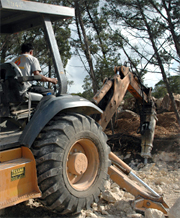
A Home
in Progress. Survey, erosion control ditching and fencing already finished.
Currently in progress: Hand clearing building site, mulching, and removal of stumps.
