
Craftsman Style Architecture
From Art & Crafts to Frank Lloyd Wright
 Steve Wauson, owner of Craftsman
Homes of Austin, is an experienced and resourceful practitioner of the
Craftsman Style in the capital city of Texas. Craftsman style homes have
stood the test of time, to some degree because of Gustav Stickley’s
dissemination of Craftsman style blueprints and later by Frank Lloyd Wright’s
Prairie homes architectural style. Their homes, especially Wright’s,
have demonstrated to be long-lasting sturdy structures, such as is his
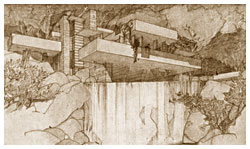
timeless iconic "Fallingwater."
“To me Arts and Craft is all about the philosophy,”
says Steve Wauson who in his work uses a great deal of style elements
and details of this movement. This philosophy originated in England
as a reaction against the Industrial Revolution and the entrenched
Victorian fashion. It purported that factory labor underpaid and
demeaned the worker. It also ended up with inferior products.
Historically, Craftsman is considered an early 20th century American
style of architecture—a subset of the British born, Arts &
Craft movement. William
Morris (1834-1896), English craftsman, poet, and early socialist,
is considered the founder of the Arts and Crafts Movement in the
later half of the1900th century. Morris encouraged the return to
handmade objects and rejected standard tastes.
This movement represented a reaction against the well established
and opulent Victorian fashion. The architect Augustus
Pugin and the writer John
Ruskin advocated the return to Gothic architecture, strongly
reacting, against the inhumanity of the Industrial Revolution and
mass production. Other countries soon followed this current, France
named it Art Nouveau and Scotland called it the Glasgow School.
Steve Wauson, owner of Craftsman
Homes of Austin, is an experienced and resourceful practitioner of the
Craftsman Style in the capital city of Texas. Craftsman style homes have
stood the test of time, to some degree because of Gustav Stickley’s
dissemination of Craftsman style blueprints and later by Frank Lloyd Wright’s
Prairie homes architectural style. Their homes, especially Wright’s,
have demonstrated to be long-lasting sturdy structures, such as is his
timeless iconic "Fallingwater."
“To me Arts and Craft is all about the philosophy,”
says Steve Wauson who in his work uses a great deal of style elements
and details of this movement. This philosophy originated in England
as a reaction against the Industrial Revolution and the entrenched
Victorian fashion. It purported that factory labor underpaid and
demeaned the worker. It also ended up with inferior products.
Historically, Craftsman is considered an early 20th century American
style of architecture—a subset of the British born, Arts &
Craft movement. William
Morris (1834-1896), English craftsman, poet, and early socialist,
is considered the founder of the Arts and Crafts Movement in the
later half of the1900th century. Morris encouraged the return to
handmade objects and rejected standard tastes.
This movement represented a reaction against the well established
and opulent Victorian fashion. The architect Augustus
Pugin and the writer John
Ruskin advocated the return to Gothic architecture, strongly
reacting, against the inhumanity of the Industrial Revolution and
mass production. Other countries soon followed this current, France
named it Art Nouveau and Scotland called it the Glasgow School.
Craftsman Style in U.S.
In the United States, Gustav Stickley—a furniture designer—between 1900 and 1916 published a magazine, “The Craftsman”, where he featured one-a-year free plans for Arts & Craft styled homes. Craftsman homes quickly became popular in the U.S. from 1900 to the 1930s, and still after a century remain relevant. Stickley and his designers belonged to the group of architects who in time would inspire the Prairie School Movement—with Frank Lloyd Wright as its icon. Craftsman homes were built for the middle class. They were low-slung bungalows that employ local wood and stone to underline the importance of nature. Some common features relevant to classic Craftsman homes are:- street-facing gables with composition or shingled roofs
- wide overhanging eaves
- deep porches
- large fireplaces
- an arched opening separating the living room and dining room
- built-in cabinetry in the dining room and kitchen
- strong construction
- beauty through simplicity
- subtlety and dignity of style
- ecological responsibility, and
- comfort
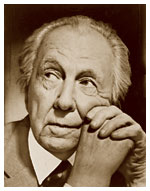 Frank
Lloyd Wright (1867-1959), single-handedly used Prairie architecture
style to bring forth a true residential prototype, the Ranch, giving
the Craftsman movement a new “edge.” Wright’s style
can be found in dozens of other housing features, including windows,
doors, roofs, and interior design.
“On adhering to Arts and Craft
ideals, we search and find the best craftspeople and artisans we can,
we compensate them fairly, look out for their safety, and greatly value
their input and their skills. They become good friends and family. There
is over a hundred years of experience on site and most of us become emotionally
vested in the projects on which we toil together.” Says Steve.
On a Wauson home all aspects of a project are centered in achieving
uniqueness. Each building is greatly influenced by the site, the
craftspeople and artisans. The woodwork, for instance, is specifically
designed for each project.
“We modernize traditional ideas by adding new technologies
and smart strategies such as rainwater collection, earth sheltering,
wildlife habitats, carbon consuming landscapes, Northern exposures,
insulation, energy and water efficiency, outdoor living spaces,
large casement and fixed glass windows, ponds, waterfalls and grottos.”
Says Wauson.
Although space is sparsely utilized in Craftsman homes, its basic
function becomes essential to the interior design. Structural elements
are commonly exposed for decoration and local materials may be enhanced
by subtle changes to the basic design.
"Our work is greatly influenced by the California Architects
Greene and Greene, and the Prairie Craftsman designs of Frank Lloyd
Wright and Fay Jones, along with Japanese architectural style. We
use many Arts and Craft or Craftsman architectural details, and
styles such as:
Frank
Lloyd Wright (1867-1959), single-handedly used Prairie architecture
style to bring forth a true residential prototype, the Ranch, giving
the Craftsman movement a new “edge.” Wright’s style
can be found in dozens of other housing features, including windows,
doors, roofs, and interior design.
“On adhering to Arts and Craft
ideals, we search and find the best craftspeople and artisans we can,
we compensate them fairly, look out for their safety, and greatly value
their input and their skills. They become good friends and family. There
is over a hundred years of experience on site and most of us become emotionally
vested in the projects on which we toil together.” Says Steve.
On a Wauson home all aspects of a project are centered in achieving
uniqueness. Each building is greatly influenced by the site, the
craftspeople and artisans. The woodwork, for instance, is specifically
designed for each project.
“We modernize traditional ideas by adding new technologies
and smart strategies such as rainwater collection, earth sheltering,
wildlife habitats, carbon consuming landscapes, Northern exposures,
insulation, energy and water efficiency, outdoor living spaces,
large casement and fixed glass windows, ponds, waterfalls and grottos.”
Says Wauson.
Although space is sparsely utilized in Craftsman homes, its basic
function becomes essential to the interior design. Structural elements
are commonly exposed for decoration and local materials may be enhanced
by subtle changes to the basic design.
"Our work is greatly influenced by the California Architects
Greene and Greene, and the Prairie Craftsman designs of Frank Lloyd
Wright and Fay Jones, along with Japanese architectural style. We
use many Arts and Craft or Craftsman architectural details, and
styles such as:
- Roofs with large eave overhangs
- Shallow roof pitches
- Roof brackets
- Roofing materials
- Siding materials
- Exposed structural components
- Unique woodwork
- Casement windows
- Large-scale plate glass windows
- Open floor plans in which the kitchen, dining room, and living room—while occupying separate areas of the overall social space—are visually linked to each other
- An assortment of materials including beige brick, honey-colored oak, and trim that wraps around all four walls of rooms, which frequently focuses on a central fireplace
- Streamlined simplicity detailing using warmth natural materials—wood or stone
A Craftsman Home
“A Craftsman home is meant to be site related and designed to enhance the surrounding natural features. In this architectural design, function does not trump form.” Says Steve Wauson, and continues, “Simplicity, subtlety and comfort are hugely important elements. We are always aware that the house we build is not what your life is about, but rather its backdrop.” For more information, click here.[ TOP ]

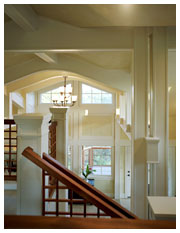
Style Influences. Horizontal
lines, Frank Lloyd Wright, Arts and Craft details of Greene and Greene,
and the square patterns of Japanese architecture, meld into a single award
winning home.
