
Consulting
Asbestos Remediation
Q
uite a few of my remodel projects through the years revealed mold, asbestos, lead, radon and other hazards. From them I’ve learned not just about abatement, but also how to prevent conditions conducive to problems.” Says Steve Wauson.
In the residential environment, asbestos greatest risk arises during remodels and additions to existing residences. Sawing, removing, disturbing or modifying components containing asbestos will release asbestos fibers into the air. This is serious and extremely dangerous. Wetting the material greatly reduces the amount of particulates becoming airborne. When dealing with materials laden with asbestos:- Cover skin
- Wear goggles and appropriate respirator
- Discard clothing after exposure —wear a painter's disposable overall with hood
- Seal clothing and removed materials in heavy-duty plastic trash bags
- Dispose bags at a facility that accepts materials containing asbestos.
- REMEMBER, KEEP EVERYTHING WET!!
 If you need to set a consultation session or want further information,
click
here.
If you need to set a consultation session or want further information,
click
here.
Asbestos Background
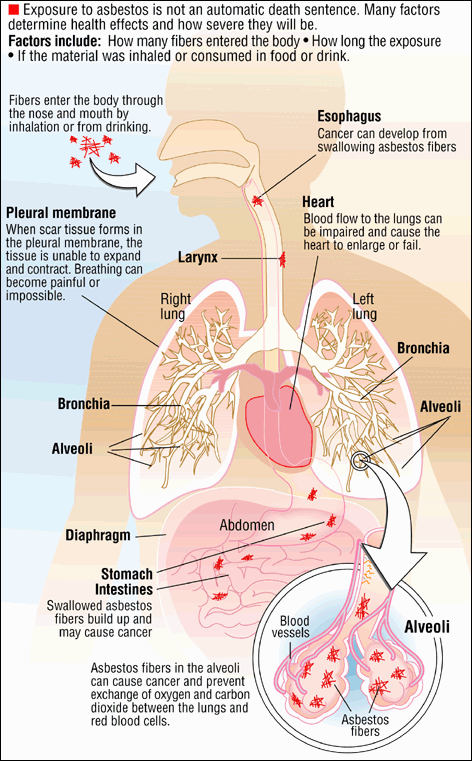
Asbestos is often found in heating system insulation, decorative spray-on ceiling treatments, vinyl flooring, and cement shake siding. It is estimated that it has been used inthousands of construction materials. Asbestos can be found in all continents. Men have used it since 3000 BC. It is an extremely stable substance, and one of the greatest insulators known to man. Asbestos is commonly mixed with other materials to form thousands of products. The Greek origin of the word means "inextinguishable" due to its resistance to chemicals and heat. In the olden times Egyptians embalmed pharaohs with asbestos. Its fibers are virtually indestructible; they do not evaporate into air dissolve in water, or break down over time. Asbestos breaks down into minute fibers. They remain suspended in the environment for hours or even days. Asbestos fibers are 700 times smaller than a human hair. Asbestos has been referred to by other names such as: "mountain leather," "incombustible linen," and "rock floss." The name of chrysotile, —a common kind, is derived from the Greek, meaning "gold fiber."Asbestos and Health
When inhaled Asbestos fibers are a known to become carcinogenic agents —only in its fibrous and airborne form. The first documented case of an asbestos-related death was reported in 1906 but it wasn’t until the 1970s, that the Environmental Protection Agency (EPA) and Occupational Safety and Health Administration (OSHA) began to regulate asbestos. Today workers are protected from exposure to asbestos as a result of very strict regulations and enforcement. Significant exposure to any type of asbestos will increase the risk of Lung Cancer, Mesothelioma, Nonmalignant lung and pleural disorders such as asbestosis, pleural plaques, pleural thickening, and pleural effusions. Diseases from asbestos exposure take a long time to develop:- Lung cancer or asbestosis —15 or more years after initial exposure.
- Mesothelioma —30 years after inception.
Types of Asbestos
The three main types of asbestos commercially used are:- Crocidolite (blue)
- Amosite (brown)
- Chrysotile (white)
Blue and brown asbestos are considered more dangerous than white asbestos.
Asbestos is found in two forms: Friable and non-friable. Friable asbestos can be easily crumbled by hand pressure. It usually appears as flakes or chunks of white material. It is the most dangerous form of asbestos because its fibers become airborne when disturbed. Non- Friable asbestos can be easily bonded with another material. The contained fibers are are less likely to become airborne unless cutting or scraping the material. Friable Asbestos:- Furnaces and Stove: Old furnaces, boilers and stoves may have been insulated with asbestos.
- Pipe Insulation. Asbestos pipe insulation looks white and chalky and may be wrapped in canvas. Another type looks like corrugated paper.
- Walls and Ceilings. Homes older than 30 years old may have walls or ceilings containing Asbestos.
Non-Friable Asbestos:
- Flooring. 9x9 and 12x12 floor tiles as well as sheet vinyl flooring may contain Asbestos. Vinyl flooring won't release asbestos fibers, unless the tiles are aggressively disturbed by scraping, wet sanded or sawed through the material. It is safe to cover asbestos containing floor tile with new flooring.
- Roofing, Shingles and Siding. Older roofing and siding materials as well as shingles may contain asbestos. Fibers are not likely to become airborne unless sawing, cutting or drilling the material. Siding containing asbestos may be re-sided over the existing material.
Recommended Links
Asbestos Contamination
[ TOP ]

- Mold Remediation
- How To "Greenscaping"
- A Green Home
- About Steve Wauson
- News and Information
- Recommended Links
- Contact Us
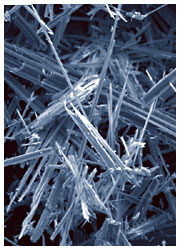
Asbestos breaks down into minute fibers, 700 times smaller
than a human hair.
